“Fraud” was one of the top Google searches in Florida this week, between a federal marriage-fraud bust in Boston and people trying to work out whether their Amazon settlement refund was real or a scam. The interest isn't random. Florida files more fraud reports per person than any other state, and vacation rental owners sit right in the path of it.
Most host scams aren't sophisticated. They work because they arrive in the middle of a busy day, look like a normal guest request and ask for one small exception. Knowing the eight patterns is most of the defense.
The Numbers Behind the Trend
From the Federal Trade Commission's Consumer Sentinel data:
Those are reported losses, so the real numbers are higher. Most people who lose a few hundred dollars to a fake guest never file anything. And rental fraud cuts both ways: the FTC logged close to 65,000 rental scam reports between January 2020 and June 2025, about $65 million in losses, and many of them used real owners' homes as bait.
The one rule that stops most of it
Every message, every payment and every refund stays on the platform. Nearly every scam below starts with a request to make one exception.
The 8 Scams, and How to Shut Each One Down
1. The off-platform payment request
A guest messages with a long-stay request, often a traveling nurse, a relocating family or an insurance placement. Within a few messages they ask for your phone number or email, then offer Zelle, a wire, a cashier's check or cash so you both 'save on fees.' Sometimes they send a screenshot of a payment that never happened.
Red flags: Asks to text or email before booking, new account with no reviews, a story that explains why normal booking won't work, urgency.
Defense: Keep every message and every dollar on Airbnb or Vrbo. Airbnb states that paying outside the platform forfeits AirCover, and it can't help with off-site payments. If a guest won't book through the platform, they aren't a guest.
2. The overpayment refund
The 'guest' pays more than the booking total, usually by check or through a payment that looks real, then asks you to send the difference back. The original payment bounces or is reversed days later. You've sent real money against fake money.
Red flags: Any payment that doesn't match the reservation, any request to refund outside the platform.
Defense: Never refund anything you haven't seen clear on the platform, and never refund to a different method or account than the one that paid. Platform refunds go through the platform.
3. Phishing that impersonates the platform
An email or message that looks like Airbnb, Vrbo or Booking.com warns of a negative review, a guest complaint or an account problem and links to a login page. Microsoft documented a campaign by a group it calls Storm-1865 that targeted hospitality businesses this way, using fake negative reviews and a fake CAPTCHA that tricked people into pasting a command that installed password-stealing malware. Once someone has your login, they can change your payout account or message your guests.
Red flags: Urgent tone, a link instead of a notification inside the app, a login page whose address isn't the platform's real domain, any page asking you to paste or run something.
Defense: Never log in from a link. Open the app or type the address yourself. Turn on two-factor authentication on every platform and on the email account tied to it, and set an alert for payout-method changes.
4. Your listing, cloned
Scammers copy your photos and description onto Facebook Marketplace, Craigslist or a lookalike site, price it well below the market and take a deposit by Zelle. In February 2026 a Tampa-area realtor found her townhouse listed on Facebook as a rental at roughly a quarter below market value. In June, Tampa Bay 28 reported on a traveler who lost a $950 Zelle deposit on a rental that didn't exist. When the real home is yours, the victims show up at your door.
Red flags: Guests asking about a price you never set, people knocking on the door mid-stay, a reverse image search that finds your photos under another name.
Defense: Reverse-image-search your hero photos once a month, watermark them lightly, report clones to the hosting site and to ReportFraud.ftc.gov, and tell guests in your listing which channels are official.
5. The edited-photo refund claim
After or during a stay, a guest submits photos of stains, pests, broken fixtures or dirty sheets and asks for a partial or full refund. Some are real. Some are from another property, and some are edited. AI editing tools have made a convincing fake trivially easy to produce.
Red flags: Damage that doesn't appear in your cleaner's photos, complaints that surface only at checkout, photos whose lighting or furniture doesn't quite match.
Defense: Have your cleaner shoot a time-stamped photo set of every room after every turnover. That record answers most disputes in minutes. Respond inside the platform's resolution tools, never by direct refund.
6. The chargeback after checkout
A guest stays, checks out happily, then disputes the card charge weeks later, claiming they never stayed or the home wasn't as described. This mostly hits direct bookings, where you process the card yourself and the bank decides.
Red flags: Direct bookings from guests with no history, mismatched names between the card and the guest.
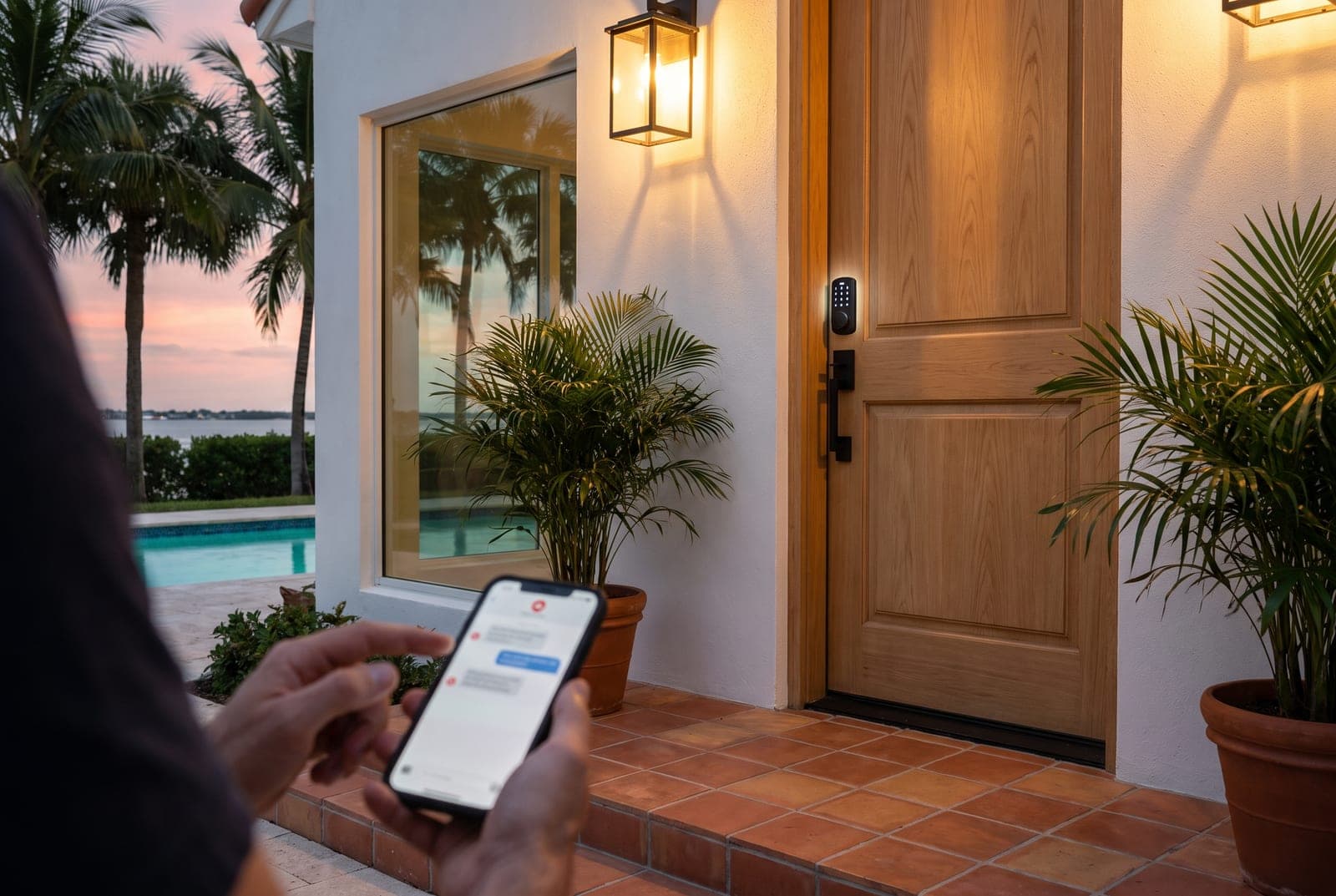
Defense: On direct bookings, use a signed rental agreement, verify ID, use a processor with fraud screening and keep your smart-lock entry log as proof of stay. On Airbnb, the guest pays Airbnb, not you.
7. The booking made for someone else
A guest with good reviews books for 'family' or 'a work team.' The people who arrive are local, younger, more numerous and planning a party. The person who booked is nowhere near the property.
Red flags: A local address on a short stay, a one-night weekend booking on a large home, vague answers about who's coming, requests to bring 'a few friends.'
Defense: Ask who is staying and why before accepting. Use a noise monitor that measures decibels only (no audio recording), set occupancy limits in writing and use neighbors as an early-warning line.
8. The guest who won't leave
A long-stay guest stops paying, or a short-stay guest simply doesn't check out and claims tenant rights. Separately, an empty home between bookings can attract unauthorized occupants with a fake lease.
Red flags: Extension requests with payment 'coming later,' month-plus stays booked off-platform, unexplained activity at a vacant property.
Defense: Put checkout time in writing at check-in, every time. Florida classifies vacation rentals as public lodging establishments, and section 509.141 of the Florida Statutes lets the operator give written notice and ask law enforcement to remove a guest who stays past that time. For unauthorized occupants of a vacant home, Florida's 2024 law HB 621 created a sheriff affidavit process. Talk to a Florida attorney before acting on a specific case.
One note on coverage: platform guarantees are not insurance, and they come with conditions that a scam is designed to break. We explained the gaps in why AirCover isn't insurance. If you're building direct bookings, scams 6 and 7 become your problem alone, so screening and a written rental agreement are not optional.
Why Tampa Bay Owners Should Pay Attention Now
Snowbird season is weeks away. Long-stay inquiries for January through March are arriving now, and long stays are exactly where the off-platform, overpayment and won't-leave scams concentrate. A month-long booking is worth enough to make the extra effort worthwhile for a scammer, and a guest who asks to skip the platform for a 60-day stay sounds more reasonable than one asking for a weekend.
Compliance is also tightening. Hillsborough's registry starts January 1, 2027, with a responsible party who must answer within an hour. A party booking or a cloned-listing victim at your door is the kind of call that responsible party will get. See our Hillsborough ordinance breakdown and the snowbird season guide for both sides of that.
If One Already Got Through: The First Hours
1. Stop the money
If you sent money by Zelle, wire or your bank, call your bank's fraud line immediately and ask for a recall. Speed matters more than anything else on this list.
2. Lock the accounts
Change the platform password and the email password, turn on two-factor authentication and check that your payout method and contact details are still yours.
3. Tell the platform
Report the user or listing from inside Airbnb or Vrbo. If a guest's stay is involved, open the case in the resolution tools so it's on record.
4. File the reports
Report at ReportFraud.ftc.gov and the FBI's IC3, and to local police for anything involving the property or a person on site. Those reports help with banks, platforms and insurers.
5. Protect the next guest
Change smart-lock codes, tell your cleaner and neighbors what to watch for and add a line to your listing about official booking channels if your photos were cloned.
Don't be embarrassed to report it. These schemes are built to fool busy, experienced people, and the reports are what let banks and platforms shut the same scammer down for the next owner.
The Ten-Minute Setup That Prevents Most of This
- Two-factor authentication on every booking platform and on the email behind it.
- An alert for any change to your payout method.
- Guest ID verification turned on, and a policy of declining unverified long stays.
- A smart lock with a unique code per reservation and an entry log.
- Time-stamped turnover photos of every room, every stay.
- Checkout time and house rules in writing, delivered at check-in.
- A monthly reverse image search of your three best photos.
Turnover photos are part of a good cleaning and turnover process anyway. They protect you from disputes that have nothing to do with fraud, too.
The Honest Version
Most guests are exactly who they say they are, and treating every inquiry as a threat costs you bookings and reviews. The goal isn't suspicion. It's a process where the scams fail automatically: payments that only move on the platform, accounts nobody can take over, a photo record for every stay and rules in writing. Owners who have that in place barely notice the scammers. The ones who don't usually find out the hard way.
At Emperor Rentals, guest screening, platform-only payments, turnover photo records and smart-lock management are part of how we run every home. If you would rather not be the person reading suspicious messages at 11 p.m., talk to us, or start with a free revenue estimate for your address.
Fraud figures come from the FTC's Consumer Sentinel Network (2024 Data Book and 2025 totals reported in FTC testimony). The phishing campaign is described in Microsoft Threat Intelligence's March 2025 report on Storm-1865. Platform policies reflect Airbnb's help center as of October 2026. Florida law references are Fla. Stat. §§ 509.242 and 509.141 and HB 621 (2024). This article is general information, not legal advice.
Written by Mark Malevskis — owner of Emperor Rentals, Tampa Bay's White-Glove vacation rental management company. Want your property protected by a process, not by luck? Let's talk →