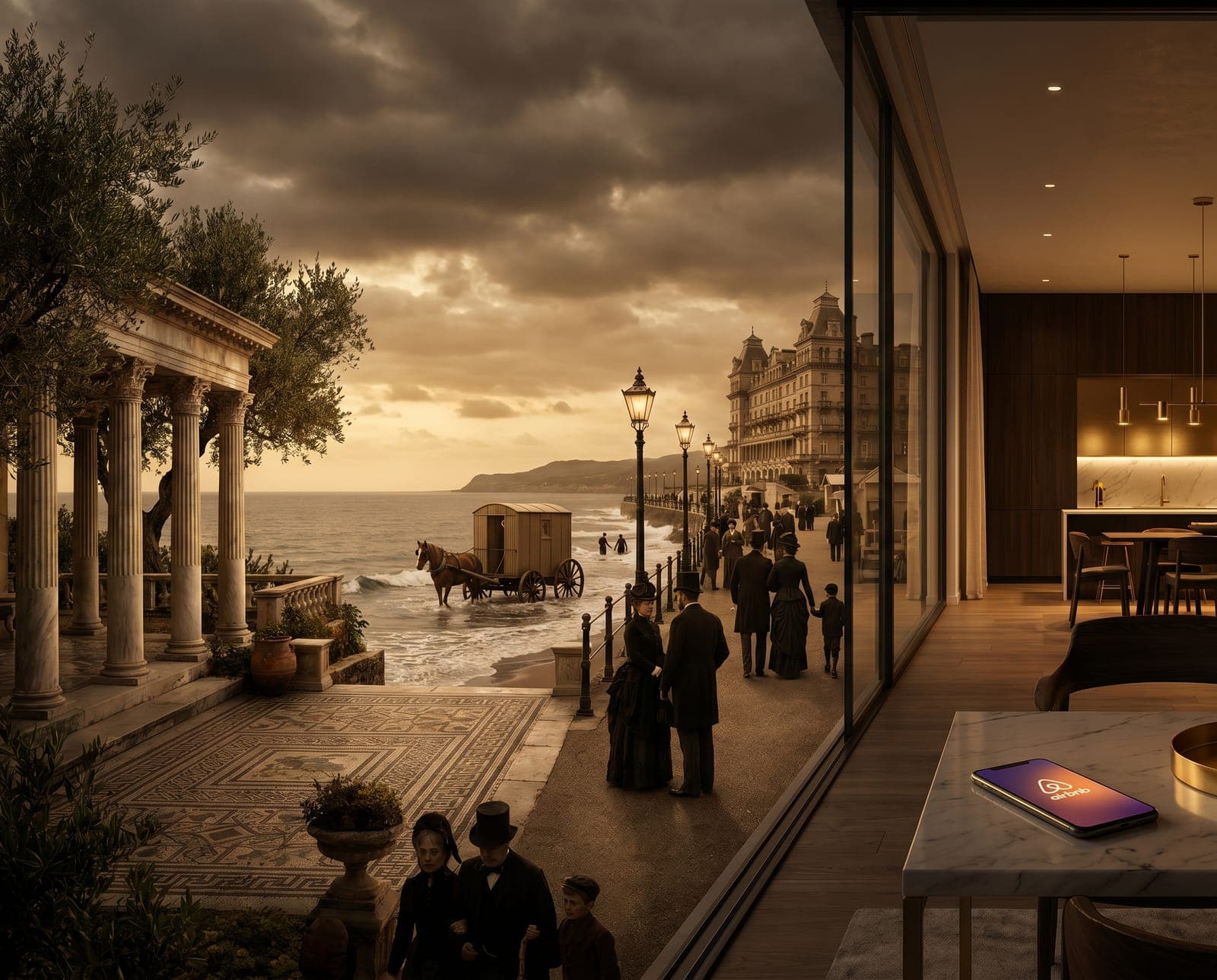
Introduction: An Idea as Old as Travel Itself
There is a scene that has repeated itself since humans first began crossing borders: someone arrives from afar, tired, with no roof for the night, and needs a place to rest. Hospitality, in this sense, is a primitive instinct — and also a business. The history of vacation rentals does not begin with a mobile app or a website. It begins much earlier, with European aristocrats fleeing the heat of Versailles, with 18th-century doctors prescribing sea bathing, with English industrial families discovering that the train could take them to the coast, and with a pair of Californian designers who couldn’t pay their rent and decided to lease air mattresses to strangers.
This is a story of human mobility, economic ambition, technological transformation, and, at its core, the universal desire to escape — even if just for a few days — from routine. To fully understand it, one must look far beyond the smartphone, the credit card, and even the internet. One must go back to the Roman baths.
Part I: The First Travelers — Antiquity and the Middle Ages
The idea of temporarily leaving one’s own home to occupy someone else’s — or to pay for it — has deep roots in human history. In ancient Egypt, the Fertile Crescent, and Babylon, travelers already found rudimentary lodging structures along trade routes. These facilities were not exactly comfortable: they were generally shared inns, where animals and humans slept in the same premises, separated only by social convention and odor.
The Roman Empire, however, elevated hospitality to a more organized level. The port cities and imperial roads (the famous Roman viae) were dotted with cauponae and mansiones — a kind of state inn for government officials and military personnel, and commercial establishments for other travelers. In Pompeii, archaeologists identified dozens of these structures, some with menus carved into the walls and private rooms — an uncommon luxury for the time.
But what most closely approximates Roman culture to the modern idea of vacation rental are the leisure villae. The Roman aristocracy built secondary properties in the hills around Rome, on the outskirts of Naples, or along the shores of Lake Como — not out of necessity, but for pleasure. The leisure villa was a status symbol and a deliberate escape from the city. Cicero had multiple such properties. Pliny the Younger described in detailed letters the pleasure of spending seasons at his villae, with meticulously planned gardens, hot baths, and libraries.
The fall of the Roman Empire and the advent of the Middle Ages, however, interrupted this cycle of leisure mobility. Travel became primarily associated with commerce or religious pilgrimage. Pilgrims crossing Europe toward Jerusalem, Rome, or Santiago de Compostela relied on hospices maintained by monasteries and religious orders — the hospitia — which were obligated, by Christian duty, to offer shelter to the traveler. There was no explicit charge, though donations were welcome.
It was only with the Renaissance and the revival of long-distance trade that travel regained a secular dimension — and, eventually, a pleasurable one.
Part II: The Grand Tour and the Traveling Aristocracy (16th–18th Centuries)
The concept of traveling as a form of education and cultural enrichment emerged in 16th-century England, but reached its peak between the 17th and 18th centuries under the name of the Grand Tour. The idea was simple: young British aristocrats — and, eventually, the nobility of other countries — would complete their education by making a long journey through continental Europe, especially France, Italy, and Germany, visiting works of art, classical ruins, royal courts, and philosophical academies.
The Grand Tour typically lasted two years and involved a retinue of tutors, servants, and baggage. It was a demonstration of wealth and civility as much as a formative experience. The young travelers did not stay in hotels — the word did not yet exist in its modern form. They stayed in rented palaces, in rooms of noble households, or were received as guests by other aristocratic families with whom their parents had relations.
Here lies the seed of the vacation rental as we know it: the idea that a private property could be temporarily ceded to a visitor, whether for money or social reciprocity. The families who lived along Grand Tour routes discovered they had a valuable product: a room, a house, a view of the Colosseum.
Communication for these bookings was done by correspondence — letters that took weeks to cross borders. With the invention of the telegraph in the 19th century, the process became only slightly more efficient, but the principle was the same: negotiating at a distance the temporary use of a space.
Part III: Sea Bathing and the Invention of the Seaside Resort (18th Century)
While the aristocracy undertook its Grand Tour, a parallel and equally transformative phenomenon was unfolding on the British coasts: the medical and social discovery of beaches.
In the early 18th century, British doctors began prescribing sea bathing as a remedy for a range of ailments: gout, hysteria, melancholy, rickets, and even rabies. The logic was straightforward within the medicine of the era — just as the thermal waters of Bath were considered therapeutic, saltwater would have even more potent healing properties. Physicians like Richard Russell, who published in 1750 a treatise on the medical benefits of seawater, were fundamental in transforming the British coastline into a medical-tourist destination.
Scarborough, in Yorkshire, was one of the first places to combine the prestige of a spa town with the novelty of sea bathing, attracting visitors since the 1730s. Soon after, Margate and Brighton, more accessible from London, became fashionable destinations. In Brighton, the frequent presence of the Prince of Wales — the future George IV — transformed the city into a symbol of coastal elegance.
To accommodate these visitors, an entirely new infrastructure emerged. Local families began renting out rooms in their homes. Inns were expanded. A key figure appeared: the coastal landlord, who during the summer months transformed their residence into an improvised guesthouse, renting rooms, providing meals, and sometimes even freshly laundered bed linen.
The first seaside resorts to develop were Scarborough, Margate, and Brighton in the 1730s, initially attracting spa-goers, since sea bathing was considered medically beneficial and pleasant.
The “bathing machines” — wooden carts pulled by horses to the water’s edge, where bathers could change clothes shielded from view — were a business in their own right. The first bathing machines appeared around 1735, believed to have originated in Devon, and became a fundamental part of bathing etiquette, especially for women.
With time, interest in the supposed health benefits gave way to a more honest appeal: pleasure. The emphasis shifted from a medically motivated visit to the sea to a pleasure-driven experience. The “golden years” of the British seaside resort were the decades around 1900.
Part IV: The Industrial Revolution, the Railways, and the Democratization of Holidays (19th Century)
For centuries, traveling for leisure was the exclusive privilege of the wealthy. The Industrial Revolution changed this — not all at once, but gradually, by creating a new urban middle class with disposable income and, eventually, free time.
The railway was the engine of this transformation. The expansion of railways meant that more people could travel across the country for coastal getaways. Before, a journey from London to Brighton took hours in a carriage along muddy roads. By train, it took less than two hours. The cost fell dramatically. Suddenly, workers from Manchester could go to Blackpool on the weekend. Middle-class families could rent a house in Weymouth for a fortnight in the summer.
The great summer holiday as we know it was conceived by the Victorians. The 19th century saw the Industrial Revolution and the rise of industrial capitalism, where factories thrived and work structures were more clearly defined, leading to the emergence of administrative professions and a rising middle class. This resulted in more structured working time, including factory shifts and Sundays off. By the 1890s, some skilled workers had Saturday afternoons free, leading to the birth of the “weekend.”
The concept of so-called “Wakes Weeks” in the industrial regions of northern England was crucial. Each factory closed on different weeks. The staggered shutdowns created a constant flow of tourists visiting the northern seaside resorts. Known as Wakes Weeks, the practice soon spread to other industries. In Scotland, it became known as Trades Fortnight; in Wales, as Miners’ Fortnight. The concept of the annual holiday had been born.
This created a market for temporary accommodation on an unprecedented scale. Coastal towns grew rapidly. Holiday homes —cottages rented by families during the season — became a structured business. By the end of the 19th century, more than 100 popular seaside resorts existed in England and Wales, from North Wales to Cornwall.
Meanwhile, across the Atlantic, a similar pattern was developing. In the United States, the idea of a vacation — of taking time off work, going somewhere to escape the heat — did not emerge until the 19th century, and was initially embraced by people who did not work very hard. It was the wealthy who, especially during the Gilded Age, began to ritualize the summer, traveling by steamship or train to resort hotels, those enormous wooden buildings that began to proliferate all along the East Coast.
And it was the wealthy — or the super-wealthy, really — who began building their own summer retreats: “camps” in the Adirondacks, “cottages” of twenty thousand square meters on the cliffs of Newport.
Part V: The Palace of Versailles and the World’s Oldest Leisure Residence
Before moving into the 20th century, it is worth making an interesting historical aside. Officially, the country house built for the French royal family in 1624, on the site where the Palace of Versailles now stands, is considered the first property built purely for leisure in history. It was, of course, the absolute exclusive domain of the monarchy — no rental was involved. But it represents the idea that a property can exist not for permanent residence, but for temporary rest and pleasure.
This distinction is fundamental: vacation rental presupposes a separation between the house where one habitually lives and the place where one goes to rest. And that separation, for centuries, was an aristocratic privilege. What the Industrial Revolution did was begin to distribute that privilege — slowly, imperfectly, but irreversibly — to ever-wider layers of society.
Part VI: The 20th Century — Road Trips, Cottages, and the Culture of the Rental (1900–1950)
The early 20th century brought two innovations that radically transformed leisure tourism: the automobile and the airplane. The car, in particular, freed the tourist from railway lines — and, by extension, from coastal towns served by train stations. The advent of the automobile allowed people to go where they wanted, not where the railways took them, and especially after the war, it allowed middle-class families to enjoy their own summer spaces. Instead of the grand porch hotel, there emerged the motor court, a small cluster of roadside cabins, and increasingly, the family property, the seaside bungalow, the small lakeside cabin.
In the 1920s and 1930s, the idea of renting a house or bungalow for the holidays was becoming part of popular culture in the United States and Western Europe. By the 1950s, renting a holiday home was a customary tradition for many, with advertisements and listings for short-term rentals beginning to appear in newspapers.
The rental of holiday homes to strangers started in the United States, around 1950, when families with available properties decided to advertise in newspapers. It was a rudimentary system: the owner described the property in a few lines — “3 bedrooms, oceanfront, with porch” — left a phone number, and waited for someone to call. The booking was made verbally. The contract, if it existed, was a simple piece of paper with the dates and the amount. Trust was mutual and, often, necessary.
World War II interrupted this development, closing beaches and diverting resources. But the post-war era brought an unprecedented boom: the “thirty glorious years” of economic growth in Europe and the United States created a broad middle class, with paid vacations guaranteed by law, affordable cars, and an insatiable appetite for leisure.
Part VII: The Timeshare — Shared Ownership (1960–1980)
At the turn of the 1960s, a new concept emerged to solve a specific problem: how to make accessible, for middle-income families, the dream of owning a vacation property at a premium destination?
The answer was born in the European Alps. Commercial air travel was increasingly becoming a necessity, and the timeshare was conceived at the height of this travel boom, with France and Switzerland hosting the first two companies to offer a vacation ownership program.
On September 23, 1963, Alexander Nette and his partner Dr. Guido Renggli created a company called “Hotel und Appartementhaus Immobilien Anlage AG” (referred to as Hapimag) in Baar, Switzerland. This company was founded on the idea that travelers should be able to enjoy vacations without paying rent every year. The duo began acquiring resort properties to sell on “right-to-use” contracts.
In France, the Société des Grands Travaux de Marseille began offering its timeshare product between 1964 and 1968. The resort offered by this company was a ski resort in the French Alps called SuperDevoluy. Potential buyers were attracted by Paul Doumier’s advertising slogan: “Don’t rent the room; buy the hotel — it’s cheaper!”
The timeshare reached the United States in 1969, in Hawaii. Vacation International brought the timeshare to America that year, opening the first U.S. timeshare resort at Kauai Kailani on the Hawaiian island of Kauai. Founders Bob Burns and Bob Ringenburg sold timeshare weeks on 40-year lease contracts.
The term “timeshare” itself has a curious origin. It was at the Brockway Springs resort in Lake Tahoe, California, in 1973, that the word was first used to describe vacation time purchased at a resort. A group of developers is credited with coining the term, adopted from its earlier use in computing, where it described the sharing of access to mainframes among multiple users. The developers believed the term would paint a clearer picture, helping buyers more easily understand the concept of shared ownership.
The 1970s brought the great innovation that popularized the timeshare: exchange companies. Resort Condominiums International (RCI) debuted in 1974, with Interval International following in 1976. Owners could now join an exchange company where, for an annual membership fee, their fixed week could be “deposited” and used at a different time or at another resort.
The 1980s and 1990s saw major hotel chains enter the business. Branded timeshare operations emphasized construction quality, professional management, and integration with hotel loyalty programs. Marriott, Disney, and Hilton leveraged existing customer relationships and brand trust to sell timeshares at premium prices. Their entry signaled the maturity of the industry and the mainstream acceptance of vacation ownership concepts.
The timeshare, however, was never free of controversy. Aggressive sales practices, hidden maintenance fees, and the difficulty of reselling shares cast a negative shadow over the industry and generated increasing regulation. Even so, the central concept — splitting the cost of a property among multiple users over time — was one of the first serious attempts to democratize access to vacation property.
Part VIII: The Digital Era Begins — VRBO and the First Websites (1995–2005)
The internet changed practically everything in the world of travel. The first step in the vacation rental sector came from a Colorado couple who had a simple problem: how to rent their ski apartment to more people?
VRBO, which stands for Vacation Rentals by Owner, was founded in 1995 by David and Lynn Clouse. The concept grew from the Clouses’ own experience renting out their ski condominium in Breckenridge, Colorado. Recognizing the potential of the vacation rental market, they launched VRBO as an online platform connecting property owners with travelers seeking unique accommodation options.
It was 1995. The web had been publicly available for less than three years. Most Americans had never sent an email. And VRBO was already online, connecting owners and guests in a way that newspaper classifieds never could. The model was simple: the owner paid an annual fee to list their property, and interested parties contacted them directly. No intermediary in the transaction, no booking fees. VRBO launched the first online vacation rental service in 1995 and was truly the first to define what the “vacation rental industry” was.
At the same time, other sites began to emerge. Booking.com was originally a travel fare aggregator, offering comprehensive hotel searches and accommodation options, but also became the first hotel reservation site to list vacation rentals. Simultaneously, Craigslist evolved from a simple email list into a website where people could post classifieds and request services online, where short- and long-term rentals were regularly advertised.
In 2005, HomeAway was founded in Austin, Texas, by Brian Sharples and Carl Shepherd. HomeAway was launched as a merger of five different sites and subsequently acquired VRBO, with its inventory crossing into the hundreds of thousands. The strategy was aggressive: consolidate the fragmented market of smaller sites into a single dominant platform. HomeAway acquired VRBO in 2006. Nearly ten years later, in 2015, Expedia purchased HomeAway to outpace Booking.com and become the world’s largest hospitality seller in terms of hotel inventory.
This period — from the mid-1990s to the early 2000s — was the digital equivalent of the newspaper classifieds of the 1950s. More efficient, geographically broader, but still fundamentally an advertising model: the owner describes the property, the guest makes contact, and the two negotiate directly. There was no unified payment system, standardized reviews, or quality guarantees. Trust was still the limiting factor.
Part IX: Two Designers, Three Air Mattresses, and the Reinvention of Everything (2007–2010)
In October 2007, two former students from the Rhode Island School of Design were behind on their rent in San Francisco. Brian Chesky and Joe Gebbia couldn’t pay their rent and decided to rent out air mattresses in their apartment to conference attendees, since all the hotels were full. They called their service “Air Bed and Breakfast.”
The first guests were two men and one woman. Each guest paid $80 to spend the night on an air mattress. After the guests left, Joe and Brian discussed the idea further and agreed to move forward.
They invited Nathan Blecharczyk — a programmer who lived in the same neighborhood — to build the website. Airbnb was officially founded in 2008 by Brian Chesky, Nathan Blecharczyk, and Joe Gebbia.
The path to success was anything but linear. After that first weekend with three air mattresses, Chesky and Gebbia brought in Blecharczyk and officially launched Airbedandbreakfast.com in August 2008. They expected it to take off. It didn’t. They got exactly two bookings. Not two hundred. Two. Total. For months, growth was essentially zero. They went to investor after investor and heard the same response: “This will never work. People aren’t going to stay in strangers’ homes.”
The company was on the verge of financial collapse when the founders had an unusual idea: create themed cereals for the 2008 American presidential campaign. They raised $30,000 selling cereal named after the two candidates — Barack Obama and John McCain — primarily at the 2008 Democratic National Convention. The “Obama O’s” and “Cap’n McCain’s” made headlines and gave the trio enough credibility to get into Y Combinator, Paul Graham’s startup incubator, in January 2009.
What happened next is business book history. With the website already built, they used their Y Combinator investment to fly to New York, find users, and promote the site. They returned to San Francisco with a profitable business model. By March 2009, the site had 10,000 users and 2,500 listings.
What set Airbnb apart from VRBO and HomeAway was not just technology — it was philosophy. Investors who finally met with them said things like: “This is an old idea. I’ve been using VRBO or HomeAway.com for years. What do these tech companies think they can do — polish something up and re-launch it on the market?” But Airbnb had understood something its predecessors had not: the barrier to renting between strangers was not technological, it was psychological. And design could solve it.
The founders noticed that hosts were taking poor photographs of their properties. The solution was to hire professional photographers to visit properties in New York and take quality photos. The impact on bookings was immediate. They understood that trust came from genuine reviews, real photos, and verified profiles. And they built a system that made each transaction less transactional and more human.
Part X: The Market Explosion and the Hotels’ Resistance (2010–2019)
Between 2010 and 2019, the vacation rental market underwent an expansion that transformed not only the hospitality sector, but entire cities around the world.
Airbnb grew exponentially. In 2011, it opened its first international office, in London. In early 2012, Airbnb opened offices in Paris, Milan, Barcelona, Copenhagen, Moscow, and São Paulo, in addition to existing offices in San Francisco, London, Hamburg, and Berlin.
The business model was elegant: Airbnb owned no properties. It was a marketplace, charging a commission on each booking — from both host and guest — and bearing none of the physical costs of maintenance, cleaning, or depreciation. It was what economists call a two-sided platform: the more guests, the more hosts wanted to join; the more hosts, the more guests were attracted.
The hotel industry was slow to react. Initially, hotel executives dismissed Airbnb as a niche, something for budget backpackers. They were caught off guard when data showed that Airbnb was capturing business travelers, families on extended trips, and groups needing multiple rooms. HomeAway alone had more than 2.8 million accommodations — more than the world’s four largest hotel chains combined.
Resistance came from multiple fronts. Hotel worker unions protested against “unfair” competition from hosts who didn’t pay the same taxes or follow the same regulations as hotels. Neighbors of frequently listed apartments complained of noise, lack of security, and an influx of strangers in their buildings. City governments in tourist destinations — Paris, Barcelona, Amsterdam, Lisbon — began imposing restrictions on short-term rentals.
The debate was — and still is — complex. Vacation rentals can raise property prices in popular neighborhoods, displacing long-term residents. They can transform residential communities into tourist districts. They can reduce the supply of housing available for long-term rental. On the other hand, they offer property owners significant supplemental income, give tourists a more affordable and authentic alternative to hotels, and distribute the benefits of tourism more broadly across the city.
In 2015, Expedia purchased HomeAway for $3.9 billion, further consolidating the market. In 2019, VRBO embarked on a strategic rebranding initiative, transitioning from HomeAway to VRBO — a decision motivated by the desire to consolidate brand identity and strengthen its market position against growing competition.
Part XI: Brazil and Latin America — A Market Under Construction
In Brazil, the history of vacation rentals has its own cultural and economic specificities. The country has always had a strong tradition of domestic travel to the coast — especially to the northeast and south — and the habit of renting beach houses during the summer is longstanding among middle-class families.
What changed was the scale and professionalization. With Airbnb’s arrival in Brazil — an office opened in São Paulo in 2012 — and the popularization of platforms like Booking.com, the market underwent a radical transformation. Properties that were previously rented through word of mouth or small signs out front suddenly had global reach.
The vacation rental market in Brazil had a projected revenue of $2.11 billion for 2023, representing growth of 19.9% compared to 2022. By 2027, the number of users is expected to reach 34.61 million people in the country.
From a legal standpoint, vacation rental in Brazil is primarily regulated by the Tenancy Law (Law No. 8,245/1991). Article 48 defines: “A seasonal rental is one intended for the tenant’s temporary residence, for leisure activities, attending courses, receiving medical treatment, carrying out works at their property, and other circumstances that derive solely from a specific period, contracted for a term not exceeding ninety days, whether or not the property is furnished.”
One of the most interesting chapters in the history of vacation rentals in Brazil is that of Stays.net, a Brazilian software company for the sector. In 2004, Sven dos Santos moved from Germany to Brazil and founded a real estate agency specializing in vacation rentals. In 2009, he asked a programmer to develop simple management software for accommodations, as spreadsheets had reached their limit. In 2016, he sold the agency and founded Stays with his co-founders Sergey and Till. In 2022, the company was acquired by the Argentine group Decolar, a clear sign that the Latin American market had matured enough to attract major regional capital.
Part XII: The Pandemic and the Reinvention of the Industry (2020–2022)
The COVID-19 pandemic was, simultaneously, the greatest trauma and the greatest catalyst the vacation rental market had ever experienced.
In 2020, the vacation rental market suffered a severe blow from the abrupt collapse of travel. Airbnb, which had been preparing for a historic IPO, saw its bookings collapse. The company laid off 1,900 employees — 25% of its workforce — in a matter of weeks.
VRBO faced severe criticism for its refund policy during the pandemic. They went through turbulent times because they had a no-refund policy during COVID, and guests wanted their money back. Everyone was sick, couldn’t travel, and the company was holding onto their funds.
But the story has a surprising twist. When lockdowns eased, vacation rentals fared far better than hotels. The reason was simple: renting an entire house was perceived as safer than a hotel full of strangers. Families who had never seriously considered Airbnb came to prefer the privacy and independence of having a property entirely to themselves. The private kitchen — once a convenience — became a necessity in times of closed restaurants.
Remote work also transformed the profile of guests. With millions of people working from home, the idea of working from anywhere — a mountain bungalow, a seaside house, an apartment in Lisbon — became not just possible, but attractive. New terms emerged: workcation (work + vacation), digital nomad, slow travel. Vacation rental stopped being just for weekend getaways and began serving stays of weeks or months.
With the post-pandemic recovery, Airbnb generated a positive annual balance for the first time. The platform announced that in 2022 it achieved a profit of $1.9 billion — $319 million in the last quarter alone — and a record 6.6 million properties listed worldwide.
Part XIII: The Global Market — Numbers and Perspectives
The current scale of the vacation rental market is difficult to overstate. The global market generated $91.2 billion in 2021 and is projected to reach $315 billion by 2031, growing at an average annual rate of 12.4%. Europe holds the largest share of the global market and is expected to continue expanding. The Asia-Pacific region shows the greatest growth potential, especially in India, China, Australia, Indonesia, and Japan.
VRBO, which started as a website for a couple renting out their ski apartment, today provides access to more than 2 million vacation properties across 190 countries.
What these numbers reveal is not just the success of specific platforms, but a structural shift in how people understand accommodation. For decades, the equation was simple: travel = hotel. Today, for a growing share of travelers — especially younger ones — that equation no longer holds automatically. The hotel has become one option, not the only one.
Part XIV: Present-Day Tensions — Regulation, Gentrification, and the Future
The explosive growth of the market did not come without consequences. The world’s leading tourist cities today face a dilemma: how to capture the economic benefits of tourism without destroying the urban fabric that attracts tourists in the first place?
In Barcelona, the city government severely restricted new registrations for short-term rentals in the historic center and popular neighborhoods. In Amsterdam, it imposed a maximum of 30 nights per year for residential rentals. In Lisbon, where the tourism boom was particularly intense during the 2010s, the number of apartments converted into short-term rentals triggered a housing crisis that pushed low- and middle-income residents out of the city center.
In Brazil, the debate took on a legal dimension. In April 2021, a ruling by the Superior Court of Justice (STJ) allowed the prohibition of digital platform rentals in condominiums, provided it was established in the condominium’s regulations. This became one of the most impactful legal precedents affecting vacation rentals in the country.
On the other side of the debate, there are legitimate arguments in favor of short-term rentals. They created a new class of micro-entrepreneurs — people who, by renting a spare room or an apartment that would otherwise sit empty, generate significant supplemental income. In communities outside major tourist centers, platforms democratized market access: a property owner in a small coastal town can now reach guests from New York, Buenos Aires, or Berlin without intermediaries.
The tension between these interests — residents, owners, platforms, municipalities, tourists — defines the contemporary debate around vacation rentals. There is no simple solution, and every city is finding its own balance.
Part XV: Technology, Artificial Intelligence, and the Next Chapter
If the Grand Tour was version 1.0 of leisure tourism, and Airbnb was version 3.0 of vacation rentals, we are now taking the first steps of version 4.0 — marked by artificial intelligence, automation, and hyperpersonalization.
Dynamic pricing systems — which automatically adjust the price of a property based on real-time demand, local events, booking history, and seasonality — have become standard among professionalized hosts. Tools like AirDNA, PriceLabs, and Wheelhouse transformed what was once the owner’s intuition into a sophisticated algorithm.
Remote management made possible what once seemed impossible: overseeing dozens or hundreds of properties without being physically present at any of them. Smart locks, outdoor surveillance cameras, home automation systems, and software-coordinated cleaning teams allow a single manager to operate what previously would have required an entire hotel company.
Artificial intelligence is also beginning to appear in the guest experience: virtual assistants that answer questions around the clock, recommendation systems that learn preferences over time, and tools that automatically generate property descriptions from photographs.
The next horizon is even deeper integration between platforms. The guest who tomorrow books a beachside house will be able, within the same interface, to arrange airport transfer, reserve a table at the highest-rated local restaurant, and receive a personalized list of activities based on their previous travel preferences.
Conclusion: Hospitality as a Human Condition
Four centuries separate the country house built for King Louis XIII in the gardens of Versailles from the apartment booked by a traveler on a mobile app. Between the two, there have been industrial revolutions, world wars, economic crises, pandemics, and technological transformations that no contemporary of Louis XIII could have imagined.
And yet, the essence of vacation rental remains surprisingly constant: someone has a place. Someone else needs a place. The two reach an agreement. What changed — radically, profoundly — is everything surrounding that exchange: the scale, the speed, the trust enabled by review systems, the price transparency, the geographic reach.
What the history of vacation rentals teaches us, above all, is that mobility is an irrepressible human desire. People have always wanted to move, explore, temporarily escape the familiar. And they have always found — whether in Roman inns, Victorian bungalows, or apartments listed on Airbnb — someone willing to offer a place to rest.
Hospitality, at its core, is not a product. It is a human condition. And as long as there are people wanting to move through the world, there will be others willing to open their homes — for money, for pleasure, for something that still has no simple name, but that has existed since the first weary travelers arrived at someone’s door and were welcomed in.
Frequently Asked Questions
What is the historical origin of vacation rentals?
Vacation rentals have roots in Antiquity, with the leisure villae of the Roman aristocracy and the inns along Roman imperial roads. The modern concept began developing in 18th-century Europe with the British seaside resorts, and became widespread in the 19th century with railway expansion and the emergence of working-class holidays. In the United States, the first newspaper advertisements for vacation home rentals date to around 1950.
When and how was Airbnb founded?
Airbnb was founded in 2008 by Brian Chesky, Joe Gebbia, and Nathan Blecharczyk. It started in October 2007, when Chesky and Gebbia rented air mattresses in their San Francisco apartment to conference attendees for $80 a night, calling the service 'Air Bed and Breakfast'. After joining Y Combinator in January 2009, the company took off rapidly: by March 2009 it had 10,000 users and 2,500 listings worldwide.
What is timeshare and when did it originate?
Timeshare is a shared vacation property ownership model where multiple owners purchase the right to use the property during specific periods. The concept emerged in Europe in the 1960s — Hapimag was created in Switzerland in 1963, and the first French resort began offering the product between 1964 and 1968. It reached the U.S. in 1969, in Hawaii. The term 'timeshare' was coined in 1973 at the Brockway Springs resort in Lake Tahoe.
What was the first online vacation rental website?
VRBO (Vacation Rentals by Owner) was the first online vacation rental service, founded in 1995 by David and Lynn Clouse in Colorado. The model was straightforward: the owner paid an annual fee to list the property and interested parties contacted them directly — no intermediary, no per-booking fees. HomeAway acquired VRBO in 2006, and Expedia purchased HomeAway for $3.9 billion in 2015.
What is the current size of the global vacation rental market?
The global vacation rental market generated $91.2 billion in 2021 and is projected to reach $315 billion by 2031, growing at an average annual rate of 12.4%. Airbnb achieved a profit of $1.9 billion in 2022, with a record 6.6 million properties listed worldwide. VRBO today offers access to more than 2 million vacation properties in 190 countries.
Own a property in Tampa Bay?
Vacation rentals have traveled centuries of history to reach the scale they’re at today. See how much your property can generate with professional management — real data from your submarket, not a generic estimate.
Get a free revenue estimate →Sources
- Stays.net — Vacation Rental: Basic Guide
- Wikipedia PT — Aluguel por Temporada
- Seazone — Vacation Rental Laws in Brazil
- Encyclopedia.com — Seaside Resorts
- Wikipedia EN — Seaside Resort
- Oxford Royale — A Brief History of the Summer Holiday
- Literary Hub — Summer Vacations Are a 19th-Century Invention of the Rich
- Sweet & Nostalgic — The History Behind British Seaside Resorts
- The Conversation — How the Victorians Invented the Staycation
- How to History — Seaside Resorts
- Quills & Quartos — Tourism in Seaside Towns
- Rentals United — History of Vacation Rentals (Infographic)
- VR Scheduler Blog — History of VRBO
- Keycafe Blog — The History of Short-Term Rentals
- Subscribed.fyi — VRBO's Past Identity
- QoreUps — VRBO Vacation Rental Marketplace Case Study
- Skift — Oral History of Short-Term Rentals, Part 1
- OwnerRez — VRBO Over the Years
- Wikipedia EN — Airbnb
- Hostaway — Airbnb Founders: The Inside Story
- Medium — The Story Behind the Unlikely Rise of Airbnb
- Wharton Knowledge — The Inside Story Behind the Unlikely Rise of Airbnb
- Growth Hackers — Airbnb Growth Study
- iGMS — Airbnb History
- How Timeshare Works — History of Timeshare
- Buy a Timeshare — History of Timeshares
- Wesley Financial Group — The History of Timeshares
- Timeshare Specialists — History of Timeshares
- RCI VIP — The History of Timesharing
- Sell My Timeshare Now — History of Timeshares & Beyond
- Baytree Solutions — A Brief History of Timeshare
- Stays.net — About Us
Written by Mark Malevskis — owner of Emperor Rentals, Tampa Bay’s White-Glove Airbnb and vacation rental management company. Learn about our management services →