Here’s the thing about spring training demand in Tampa Bay: it isn’t one event. It’s four simultaneous events, each anchored to a different city, a different fan base, and a different neighborhood within the same metro area. The Yankees bring New York money to Tampa. The Phillies bring Philadelphia families to Clearwater. The Blue Jays bring Canadian snowbirds — who are often already here — to Dunedin. The Pirates bring Pittsburgh diehards to Bradenton.
Most rental owners think of “spring training season” as a vague February–March bump and price accordingly. The owners who understand the team-by-team geography treat it as four separate demand events — each with its own peak weekends, its own guest profile, and its own pricing ceiling. The difference in annual revenue between those two approaches is not trivial.
This guide breaks down the Grapefruit League demand picture for Tampa Bay property owners: which teams train where, who their fans are, when the highest-demand weekends fall, and how to position your property to capture it.
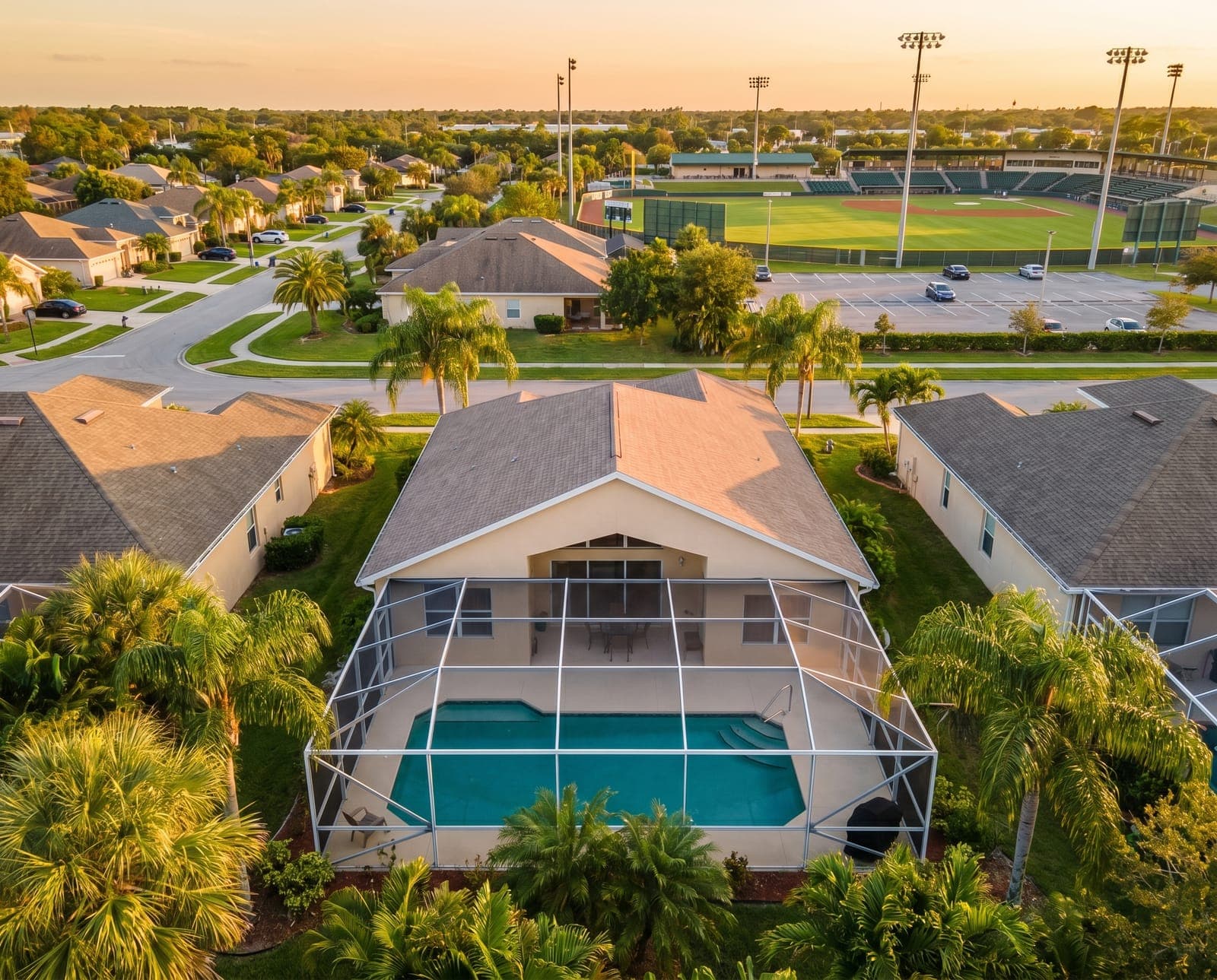
The Four Teams and Their Neighborhoods
The Grapefruit League schedule runs from roughly February 20 through March 27, with players reporting to camp as early as February 12. The full demand window — including travel arrivals, practice sessions open to fans, and the back-to-back home-game weekends — effectively spans six weeks.
- —New York Yankees → George M. Steinbrenner Field, Tampa: The Yankees train at a dedicated 11,000-seat facility in northwest Tampa, about 10 miles from downtown. Yankees fans are arguably the most geographically diverse in baseball — and the most willing to spend. A weekend series at Steinbrenner Field draws visitors from the tri-state area, Florida transplants from New York, and international fans. Properties in South Tampa, Hyde Park, Westchase, and Carrollwood are the primary beneficiaries. Weekend home-game dates typically see rate ceilings 25–40% above baseline for well-positioned Tampa properties.
- —Philadelphia Phillies → BayCare Ballpark, Clearwater: The Phillies play at BayCare Ballpark in downtown Clearwater, roughly two miles from Clearwater Beach. Their fan base — Philadelphia, South Jersey, Delaware Valley — has an unusually strong tradition of traveling to spring training, and Clearwater Beach is a major part of the draw. Fans come for the games and stay for the beach. This creates compounding demand: Phillies weekend home dates overlap with the peak of snowbird season and spring break arrivals. For Clearwater Beach owners specifically, a Phillies home weekend in early March can represent the highest-ADR days of the entire year.
- —Toronto Blue Jays → TD Ballpark, Dunedin: The Blue Jays have trained in Dunedin since 1977 — it's one of the longest-running spring training relationships in baseball, and Dunedin has a legitimate Blue Jays fan culture built around it. The fan base arriving from Toronto, Southern Ontario, and the broader Canadian snowbird community creates a layered demand effect: many Blue Jays fans are already wintering in the Tampa Bay area as snowbirds and simply adjust their February plans around the home schedule. Dunedin, Safety Harbor, and north Clearwater properties benefit most. The Canadian visitor demographic is typically 45–70, stays 5–10 nights, and prioritizes comfort and proximity over budget.
- —Pittsburgh Pirates → LECOM Park, Bradenton: LECOM Park in Bradenton is just south of the Hillsborough County line — technically Manatee County, but 35–45 minutes from central Tampa Bay. The Pirates fan base traveling from Pittsburgh and western Pennsylvania tends to be deeply loyal but budget-conscious compared to Yankees and Phillies travelers. Properties in Bradenton, Palmetto, and the southern reaches of St. Pete benefit from home-game weekends. The demand here is real but less price-elastic — the pricing opportunity is more about occupancy than rate premium.
The Calendar Overlap Problem — and Opportunity
Spring training runs almost exactly concurrent with snowbird season. January through March is already the highest-demand window of the year for Tampa Bay vacation rentals. Spring training doesn’t create a separate demand event on top of that baseline — it creates demand spikes within it.
What that means practically: your baseline February occupancy is already high because of snowbirds and general winter demand. Spring training weekend dates layer additional competition for available inventory on top of that. A Clearwater Beach property that would normally book a mid-February weekend at $280/night might see genuine demand at $380–$420/night on a Phillies home weekend, because the pool of available properties is smaller and the guests arriving for the game are willing to pay to be close.
The owners who capture this are the ones who identify the specific home-game dates for the team closest to their property and adjust rates 6–8 weeks in advance — before the search volume spikes and before the competing properties around them react. The owners who don’t are the ones who see a fully booked calendar in March and think the season went well, without ever knowing what they actually could have earned.
Who Are Spring Training Guests?
Spring training visitors are not a homogeneous group, but there are consistent patterns by fan base that matter for how you position your listing.
Yankees Fans: Groups Who Book Early and Spend Freely
Yankees spring training visitors tend to travel in groups — a dad and two adult sons, a group of college friends who grew up in New Jersey, a couple from Long Island who make the trip every year. The group size (3–6 people) makes vacation rentals a natural fit: the cost splits well, you get a kitchen and living space, and you’re not paying for three hotel rooms. This demographic books 4–6 weeks in advance, has a relatively high price ceiling, and is more focused on proximity to Steinbrenner Field and Tampa nightlife than on beach access.
Phillies Fans: Family Groups Who Want the Beach Too
Phillies fans traveling to Clearwater almost always combine the baseball trip with Clearwater Beach time. A family of four flying in from Philadelphia books a 5-night stay, goes to two or three games, and spends the rest of the time on the beach. This creates strong demand for 2–3 bedroom properties within a 15-minute drive of both BayCare Ballpark and the beach. The guest profile is family-oriented, moderately price-sensitive but willing to pay for the right property, and very review-aware — they research properties thoroughly before booking.
Blue Jays Fans: Canadian Snowbirds Who Already Know the Market
The Blue Jays visitor is uniquely layered. Some are pure spring training travelers flying in from Toronto for a long weekend. But a significant share are Canadian snowbirds already wintering in the Tampa Bay area — either in their own properties or already renting nearby — who simply extend their stay or shift dates to align with the home schedule. This demographic (typically 50–70, traveling as couples or small groups) has already self-selected for longer stays and is highly familiar with the Dunedin and Clearwater area. They’re less likely to need location guidance and more likely to repeat-book a property they’ve stayed at before.
How to Price for Spring Training Weekends
The mechanics of spring training pricing are similar to pricing for any event-driven demand spike — but there are a few specifics worth calling out.
Identify Your Team’s Home Schedule First
Home games drive the strongest localized demand. Away games matter too — when the Phillies play in Tampa at Steinbrenner Field, for example, both Clearwater and Tampa see elevated demand — but the home schedule is the primary pricing trigger. Download the Grapefruit League schedule from MLB.com as soon as it’s published (typically late November) and mark every home-game weekend for the team training nearest your property.
Adjust Rates 6–8 Weeks in Advance
Spring training travelers — particularly the family and group segments — book 4–6 weeks ahead. If you wait until two weeks before a home-game weekend to raise rates, the high-value guests have already booked elsewhere. Set your event-weekend rates by early January for February dates, and by mid-January for March dates.
As a general starting point: on weekends with back-to-back home games (Friday through Sunday), a 20–40% premium over your standard February rate is defensible for properties near the relevant ballpark. Properties within 5 miles of BayCare Ballpark or Steinbrenner Field have the most pricing leverage.
Consider a 3-Night Minimum for Game Weekends
Unlike snowbird guests who book 2–3 week stays, spring training visitors typically book 3–6 nights. A 3-night minimum on event weekends prevents the single-night booking that blocks your calendar at a lower rate, while still accommodating the typical group itinerary of a game on Friday night, Saturday, and Sunday with travel on Monday.
Don’t Forget the Mid-Week Training Attendance
Spring training facilities host open practice sessions and autograph sessions on non-game days, and a portion of fans build their trips around weekday access to the facility. This creates softer but real mid-week demand that a dynamic pricing tool calibrated to the event calendar will capture automatically. If you’re self-managing, it’s worth a manual rate adjustment upward for the full 5–6 week window, not just weekend dates.
Optimizing Your Listing for the Baseball Guest
Spring training guests are searching differently than snowbirds or summer vacationers. A few listing adjustments can meaningfully improve your conversion rate during the Grapefruit League window.
- —Distance to ballpark in your listing title or first paragraph: "10 minutes to BayCare Ballpark" or "5 miles from Steinbrenner Field" is a direct search qualifier. Guests filtering by proximity will skip listings that don't surface this clearly.
- —Call out parking explicitly: Groups driving to games need guaranteed parking, not street parking that depends on availability. If you have a driveway or covered spot, say so prominently. It's a booking driver for the car-dependent spring training visitor.
- —Outdoor space for pregame gatherings: A backyard, patio, or screened lanai where a group can have drinks before the game is a differentiator for the group-travel segment. Photograph it well and mention it in your listing description.
- —Update your house manual with local baseball logistics: Parking at the ballpark, nearby bars with pregame atmosphere, the best route to avoid game-day traffic — guests appreciate this kind of local knowledge, and it drives five-star reviews from a demographic that tends to be vocal online.
The Compounding Effect: Spring Training + Snowbird Season Together
If you own a property near Clearwater Beach or in South Tampa, February and March already represent your highest-revenue weeks of the year because of the snowbird demand window. Spring training layers on top of that, creating a February–March environment where your property can be priced at premium rates with genuine demand to support it.
The practical implication: don’t leave the spring training window inside a flat “winter rate” block. A Clearwater Beach property set at a uniform $300/night from January through March is underpricing Phillies home-game weekends (where $380–$420 is defensible) and possibly overpricing slower mid-January weekdays. The more granularly you manage the window, the more revenue you extract from it.
Tools like PriceLabs can capture some of this automatically if configured to monitor the local event calendar. But as with any dynamic pricing tool, the algorithm needs active oversight — especially for events like spring training where the demand signal is real but the algorithm’s detection of it varies by market configuration.
What This Looks Like in Practice
Let me give you a concrete example. We manage a 3-bedroom home in north Clearwater — not beachfront, but within 12 minutes of BayCare Ballpark and 18 minutes of Clearwater Beach. The property runs at roughly $240/night as its standard February rate, with snowbird demand keeping it consistently booked.
During the 2025 Grapefruit League season, we identified four Phillies home weekends between February 22 and March 16 that aligned with back-to-back game days. We raised rates to $340–$365/night for those weekends specifically, six weeks in advance. All four booked out fully — two by groups from the Philadelphia area, one by a family from Delaware, one by a mixed group that included two Blue Jays fans who came for an interleague game.
The delta on those four weekends alone was just under $2,400 above what a flat winter rate would have generated. That’s from four targeted rate adjustments, made six weeks in advance, for a property that wasn’t even on the beach.
Frequently Asked Questions
Which MLB teams train in the Tampa Bay area?
Four MLB teams hold spring training in the greater Tampa Bay area: the New York Yankees at George M. Steinbrenner Field in Tampa, the Philadelphia Phillies at BayCare Ballpark in Clearwater, the Toronto Blue Jays at TD Ballpark in Dunedin, and the Pittsburgh Pirates at LECOM Park in Bradenton.
When does MLB spring training run in Tampa Bay?
Grapefruit League games typically begin in late February (around February 20–22) and run through late March (around March 25–27), with pitchers and catchers reporting to camp as early as mid-February. The full spring training window effectively spans February 15 through March 28.
How much does spring training increase vacation rental demand in Tampa Bay?
Weekend home-game dates for each team create localized demand spikes of 20–45% above baseline February rates in the neighborhoods closest to each ballpark. The effect is neighborhood-specific — not uniform across the whole Bay.
Do spring training visitors stay in vacation rentals or hotels?
A significant share of spring training visitors prefer vacation rentals, especially groups of 3–6 who split costs across a 3–7 night stay. The fan demographic — typically adults aged 35–65 traveling with family or friends — is well-suited to rental properties with a kitchen, parking, and space to gather.
Are your rates set for next spring training season?
The Grapefruit League schedule drops in November. The owners who have their pricing ready by January capture the early-booking wave at full rates. Let’s review your property’s spring training potential and build a pricing strategy before the window opens.
Get a free revenue estimate →Written by Mark Malevskis — owner of Emperor Rentals, Tampa Bay’s White-Glove Airbnb and vacation rental management company. Learn about our management services →