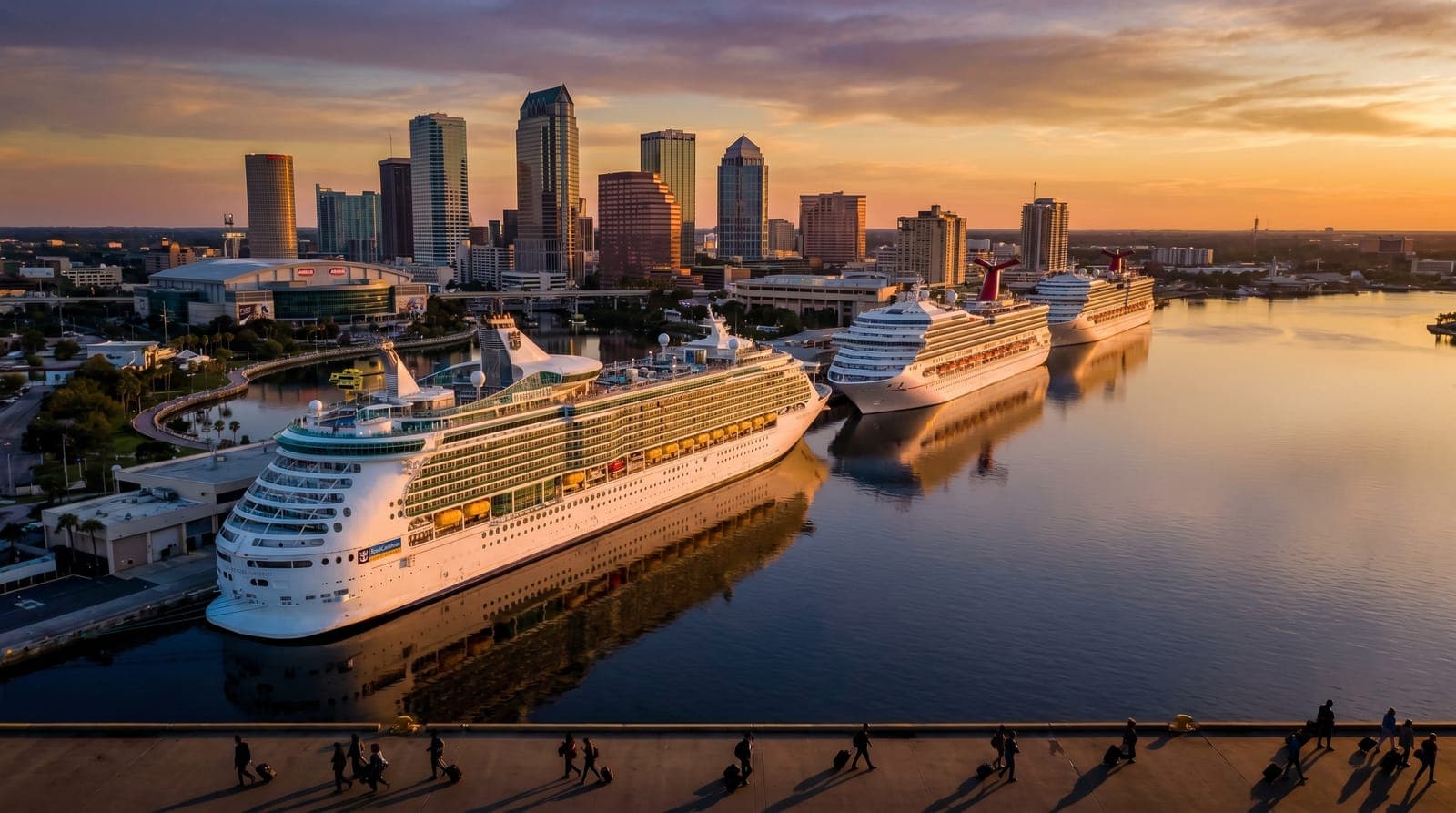
On a Tuesday morning in early March, the Channel District woke up to something that has become increasingly normal for Tampa — three massive cruise ships lined up at Port Tampa Bay simultaneously. Carnival Paradise, Norwegian Star, and Royal Caribbean’s Enchantment of the Seas. Thousands of passengers boarding. Thousands more disembarking. Families rolling suitcases through Channelside Drive. Couples checking their phones for Ubers, for Airbnbs, for somewhere to eat before their 11 AM flight home.
This happened ten times in March 2026. Ten days where three ships were in port at once. And March finished with 51 total cruise calls — the busiest single month in Port Tampa Bay’s history.
For most Tampa residents, that’s just traffic on the Selmon. For vacation rental owners who already know how strong the Tampa Bay STR market is, it should be something else entirely: a calendar of demand events they can plan around, price around, and profit from — if someone is actually paying attention.
The Numbers Behind the Record
Port Tampa Bay isn’t new to cruising. What’s new is the scale.
In 2025, the port handled 1.6 million cruise passengers. In 2026, the projection is 1.8 million — and the infrastructure to support it is already in motion, including a fourth cruise terminal currently in development. Five major cruise lines now call Tampa home port: Carnival, Royal Caribbean, Norwegian, Celebrity, and Margaritaville at Sea. The combined annual economic impact of cruise activity through Tampa Bay now exceeds $15.1 billion.
That is not a typo. Fifteen billion dollars. Moving through restaurants, hotels, rideshares, tour operators, and yes — short-term rentals — in and around the Tampa Bay area.
The question isn’t whether cruise tourism is good for Tampa. It clearly is. The question is whether your property is positioned to capture any meaningful share of it.
Who Are These People, and Where Do They Sleep?
Here’s something the cruise industry knows well that the local vacation rental market is only beginning to understand: most cruise passengers don’t just show up the morning of embarkation.
The industry standard recommendation — pushed by every cruise line, every travel agent, and every cruise forum — is to arrive in Tampa the night before your departure. Flight delays, luggage issues, traffic from Orlando or Miami. The risk of missing the ship is real, and veteran cruisers know it. So they book accommodation the night before. And on the back end, many extend their Tampa stay for a night or two after returning — because they’re already here, the weather is good, and they want to see Ybor City or catch dinner on Water Street before driving home.
With 1.8 million passengers moving through the port in 2026, even a conservative estimate — say 20% extending their stay by one night — is 360,000 additional room-nights of demand. In a metro area. That’s not a niche. That’s a sustained, predictable, calendar-able demand stream that repeats every single week.
The Neighborhoods That Benefit Most
Not every Tampa property benefits equally from cruise traffic. Location matters — but “location” in this context is broader than most owners assume.
The obvious winners are in the Channel District and Downtown Tampa. Five minutes from the terminal. Walkable to Sparkman Wharf, the Amalie Arena, and the Riverwalk. A cruise guest arriving at 3 PM the day before departure wants exactly this: walk somewhere for dinner, have a drink, not worry about parking, and wake up with plenty of time to get on the ship. A well-managed Channel District or Downtown condo captures this almost on autopilot when the listing is positioned correctly.
But Ybor City, SoHo, Hyde Park, and South Tampa also do extremely well with cruise-adjacent guests. These travelers — especially the ones staying post-cruise — want the Tampa experience, not just proximity to the port. They’ve just spent a week on a ship. They want a neighborhood, a restaurant they can walk to, a bar that doesn’t seat 3,000 people. South Tampa delivers that. Ybor delivers it at a different price point. Both are 10 to 20 minutes from the terminal.
Even properties in Brandon, Riverview, or the Westshore corridor can capture cruise-driven demand when priced correctly and when the listing explicitly surfaces cruise port proximity. “15 minutes from Port Tampa Bay, free parking, easy Channelside access” is a real selling point to a family of five driving in from Georgia.
Why Most Owners Are Missing This
This is where it gets honest.
The owners who are capturing cruise demand aren’t doing anything magical. They’re doing three specific things that most self-managing owners either don’t have time for or don’t know to do:
1. They’re watching the port schedule
Port Tampa Bay publishes its cruise schedule. Ship names, departure dates, estimated passenger counts. A property manager worth anything cross-references this calendar against their owner’s booking calendar and adjusts minimum stays and nightly rates accordingly — raising rates for high-traffic ship days, reducing minimum stays to capture the one-night pre-cruise guest who books at the last minute.
Most self-managing owners have a set nightly rate or a basic dynamic pricing tool that doesn’t account for port activity. They’re leaving $30 to $80 per night on the table on every busy ship day — and there were 51 of them in March alone.
2. Their listings explicitly target this audience
When a couple in Cincinnati searches Airbnb for Tampa on March 14th — the night before their Carnival departure — they’re not searching “beautiful downtown condo.” They’re searching “near Tampa cruise port,” “Port Tampa Bay,” “close to Channelside.” A listing that speaks directly to this — that mentions the port, the proximity, the easy morning logistics — gets clicks that generic listings don’t.
This sounds obvious. And yet most Tampa listings don’t mention the cruise port at all in their title or description. It’s a gap that costs real bookings.
3. They can actually respond at 11 PM on a Wednesday
Pre-cruise bookings often happen late — the night before or even day-of. Someone’s connecting flight landed at TPA at 9 PM. Their original hotel fell through. They need a place tonight. They message three listings and book the first one that responds.
If you’re managing your own property and you’re at a school event, asleep, or simply exhausted from a long week — you miss it. The booking goes to someone else’s listing. This happens more than owners realize, and it’s one of the most direct arguments for professional cohost management: 24/7 response capability isn’t a luxury feature. It’s a revenue feature.
The DIY Owner’s Honest Calculation
We talk to a lot of self-managing owners. Many of them are genuinely good at it — good reviews, solid occupancy, real revenue. But there’s a pattern we see repeatedly: the ones who are best at it are also the ones who are most exhausted by it.
Ricardo, a South Tampa owner who manages two properties himself, told us something last February that stuck. “I made $74,000 last year. But I also answered guest messages every night for 365 days. I didn’t take a real vacation. My wife stopped asking me to leave my phone at dinner. I don’t know what that’s worth, but it’s something.”
The math of DIY management is rarely just the management fee you’re “saving.” It includes: late-night guest messages, last-minute cleaner coordination, maintenance calls at inconvenient times, the mental overhead of checking occupancy reports, pricing adjustments you mean to make but don’t, and the compound effect of a few bad reviews that came in because response time slipped during a stressful week.
With Tampa now projecting 394 cruise ship calls across 2026 — more than one per day — the pace isn’t slowing. The question is whether you want to run a hospitality business indefinitely or own a revenue-generating asset that someone else runs for you.
What “Managed Well” Actually Looks Like Here
For Tampa properties near the cruise corridor, a competent management approach in 2026 should look like this:
Port schedule integration
The cruise calendar feeds directly into your pricing strategy. Three-ship days — like the 10 Tampa saw in March — should automatically trigger rate increases and minimum-stay adjustments two to three weeks in advance, before demand spikes and competitors catch up.
Listing language that speaks to cruise travelers
Your title and first 200 words need to surface Port Tampa Bay proximity. Not as a footnote — as a feature. This alone meaningfully improves click-through on cruise-date searches.
Flexible minimum stays for late-booking guests
Pre-cruise bookings are often one-night. If your listing requires a two-night minimum, you block an entire category of high-value guests. Smart management opens the calendar dynamically, accepting one-night bookings on nights that would otherwise sit empty.
24/7 guest response with local context
When a guest messages at 10:30 PM asking if there's parking for their rental car before embarkation, they need a real answer within minutes, not a template response the next morning. Fast, accurate, local communication is what gets five-star reviews from cruise guests.
Post-cruise upsell positioning
Post-cruise stays are often extended spontaneously. A guest who planned to check out Sunday might decide Friday evening they want two more days in Tampa. A managed listing has flexible checkout protocols and immediate booking confirmation. A self-managed owner may miss the extension entirely because they didn't see the message.
A Note for Owners Already Working With a Manager
If you already have a property management company handling your Tampa rental, here’s a simple test: ask them what their strategy is for Port Tampa Bay cruise days. Specifically.
If they give you a vague answer about “dynamic pricing tools” or say they use PriceLabswithout explaining how cruise activity is factored into their adjustments — that’s a gap. It doesn’t necessarily mean they’re bad. It means they’re managing your property generically, not locally.
Generic management in a market with this many predictable demand events is an expensive way to feel like you have a manager. The right partner should be able to tell you, with specifics, how they’re pricing March 14 differently from March 13. How they’re targeting the family of four driving in from Atlanta for the Carnival departure on the 15th. How they know that Gasparilla, March Spring Break, and the high-volume cruise weeks create overlapping demand that requires active, not automated, calendar management.
If they can’t explain that, the fee you’re paying is covering administration, not optimization.
What This Looks Like in Real Revenue
Let’s be concrete. A two-bedroom property in South Tampa, listed at a flat $175/night, generates around $38,000 annually at 60% occupancy. Reasonable but not exceptional.
The same property, professionally managed with cruise-aware dynamic pricing, cruise-targeted listing optimization, and 24/7 response capability, typically runs at 68–74% occupancy and achieves an average nightly rate 22–30% higher during high-demand periods — cruise days, Gasparilla week, spring break, the Outback Bowl weekend, Tampa Bay Lightning playoff runs.
The difference in gross annual revenue: $14,000 to $19,000. After the management fee, the net gain is still $8,000 to $13,000 — plus the owner isn’t managing anything.
That’s not a hypothetical. That’s the average spread we see between self-managed and professionally managed properties in comparable Tampa neighborhoods, based on real portfolio data. The gap exists because Tampa has more predictable demand events per year than almost any comparably sized Florida market — and capturing them requires attention that most owners, fairly, just don’t have.
Tampa’s Cruise Boom Is Just Getting Started
Port Tampa Bay is building a fourth cruise terminal. That’s not a rumor — it’s a confirmed infrastructure project designed to accommodate one million additional passengers annually. When it opens, the demand footprint for pre- and post-cruise stays across the Tampa metro will expand meaningfully.
The owners who start positioning their properties now — in their listing language, their pricing strategy, their response infrastructure — will have a head start on a demand wave that’s going to be very visible in the data two years from now.
The owners who are still running flat-rate nightly prices and managing their own calendars when that terminal opens will spend a lot of time wondering why their occupancy isn’t matching what the headlines suggest it should be.
51 ships in March. 394 scheduled for the full year. 1.8 million passengers. Every one of them potentially sleeping somewhere in Tampa the night before they board — or the night after they return.
The question is whether “somewhere” is your property.
Frequently Asked Questions
How does cruise traffic at Port Tampa Bay affect Airbnb demand?
Cruise passengers typically arrive in Tampa the night before embarkation and often stay 1–2 nights after returning. With Port Tampa Bay projecting 1.8 million passengers in 2026, this creates a predictable, high-volume demand spike around every ship departure and arrival day. Properties within 15–20 minutes of the port — Channel District, Downtown Tampa, Ybor City, SoHo, South Tampa — capture strong pre- and post-cruise bookings, especially during the 10 three-ship days Tampa saw in March 2026.
Which Tampa neighborhoods perform best for vacation rentals near the cruise port?
Channel District and Downtown Tampa are closest and see direct pre-cruise demand. Ybor City, SoHo, Hyde Park, and South Tampa also do well because post-cruise guests want a neighborhood, not just a hotel near a terminal. Properties in these areas can command $25–$60 above their standard nightly rate on high-traffic ship days.
Can a professional manager really optimize pricing for specific cruise ship days?
Yes. A good Tampa vacation rental manager tracks the Port Tampa Bay schedule and adjusts pricing, minimum stays, and availability windows weeks in advance. Capturing just 30% of Tampa's cruise-day demand spikes can add $4,000–$9,000 annually to a well-located property's gross income.
What cruise lines use Port Tampa Bay in 2026?
Five major lines: Carnival Cruise Line (Carnival Paradise), Royal Caribbean International (Enchantment of the Seas), Norwegian Cruise Line (Norwegian Star), Celebrity Cruises, and Margaritaville at Sea. The port handled 1.6M passengers in 2025 and projects 1.8M in 2026.
Owner, Emperor Rentals. Short-term rental operator and manager in the Tampa Bay area since 2019. Manages vacation rental properties across Hillsborough and Pinellas counties.