On May 14th, the Southwest Florida Water Management District quietly approved the environmental resource permit for Tampa WOW! — a 250-foot observation wheel planned for a stretch of Channelside Drive near the Florida Aquarium. The permit had been the last major hurdle. Construction is now set to begin this summer. The wheel is expected to open before the end of 2026.
Most Tampa residents heard about it. Most vacation rental owners in Tampa Bay filed it under “cool city news” and moved on with their day.
That’s understandable. It’s a wheel. It’s not a convention or a hurricane season or a regulatory change. But the owners who understand what large-scale waterfront attractions actually do to tourism demand — to the guest profiles that flow through a city, to the neighborhoods that guests choose, to the average length of stay — are paying close attention. Not because it’s exciting news. Because it’s a demand signal. A big one. And it’s six months away.
What Tampa WOW! Actually Is
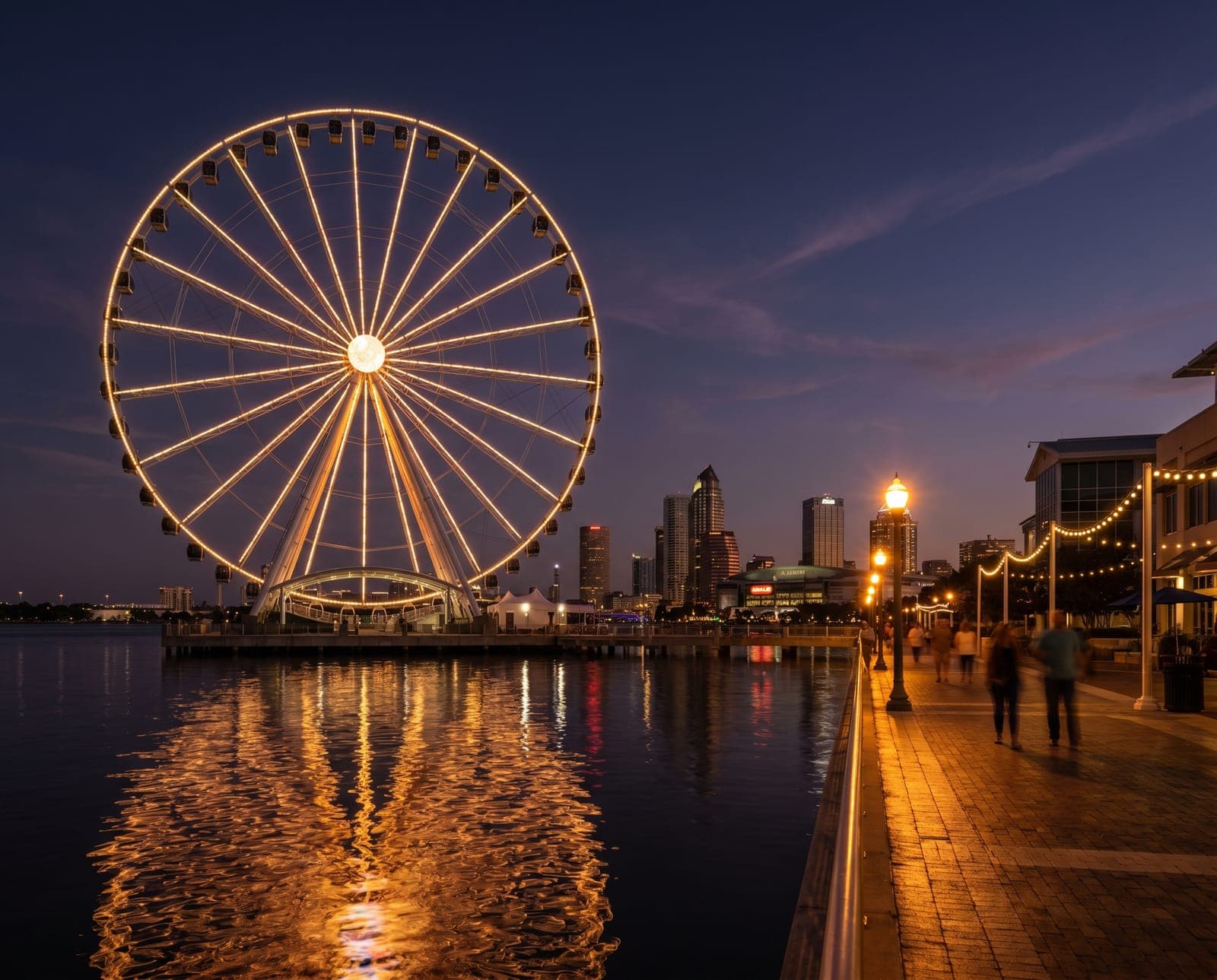
The project — officially called Tampa WOW!, which stands for Wheel Over Water — is a $20 million private investment, meaning no taxpayer money. The wheel stands 250 feet tall, taller than most buildings in the Channel District, and will feature climate-controlled gondolas offering 20 to 30-minute rides above the waterfront. It also includes a 50-seat restaurant at the base.
The location is deliberate. The one-third-acre site on Channelside Drive sits between Water Street Tampa, the Florida Aquarium, and the mouth of the cruise port. It’s in the center of the fastest-developing corridor in downtown Tampa — a neighborhood that, five years ago, most Tampans considered an afterthought, and that today hosts the city’s only five-star hotel, its most ambitious waterfront development, and one of the top-rated aquariums in the Southeast.
There have been mixed reactions locally. Some residents near Channelside are worried about parking — the area is already strained by cruise traffic and Aquarium visitors, and the wheel’s footprint takes over existing waterfront spaces. That’s a legitimate concern and probably means the city will need to solve a logistics problem it’s been kicking down the road. But for visitors, and for the short-term rental market, the parking headache doesn’t reduce demand. It redirects it toward neighborhoods where guests can walk to everything — which is exactly where well-managed vacation rentals tend to live.
Tampa Was Already Performing at a Level Most Markets Don’t Reach
Before we get to the wheel, it’s worth naming what it’s landing on top of. Because the context matters.
In March 2026, Hillsborough County generated $134.48 million in taxable hotel revenue— the highest single month in the county’s history. Only the third time ever that the $130 million threshold had been crossed. That wasn’t a fluke from one big convention. It was the product of sports tourism, cruise activity, cultural festivals, spring break, and the kind of general leisure travel that happens when a city has genuinely become a destination rather than a stopover.
Clearwater Beach was named the #1 beach in the United States for the second consecutive year by Travel + Leisure readers. The Dalí Museum just announced a $65 million expansion — 35,000 additional square feet, new immersive galleries, opening in 2028. Port Tampa Bay is building a fourth cruise terminal. SOF Week brought 20,000 military and government visitors to Tampa this month.
Tampa isn’t a city trying to attract tourism. It’s a city in the middle of a sustained, multi-year tourism expansion with more infrastructure coming online every quarter. Tampa WOW! doesn’t change the direction — it amplifies something that’s already moving fast.
Why a Ferris Wheel Isn’t Just a Ferris Wheel
There’s a pattern that plays out in tourism markets when a major, visible attraction opens on a waterfront. It happened in Pittsburgh with the Andy Warhol Museum anchoring the North Shore. It happened in Nashville with the pedestrian bridge and the honky-tonk corridor. It happened, more famously, with the London Eye turning the South Bank from a grey stretch of Thames real estate into the city’s most visited destination.
The attraction doesn’t just bring people who want to ride it. It creates a reason to linger. It turns a two-night trip into a three-night trip. It gives families and couples a “must-do” anchor that makes the whole vacation worth booking. And once a neighborhood has that anchor, the restaurants, the bars, the boutiques, and the vacation rentals nearby all benefit from the extended time guests spend in the area.
The Channel District and the broader Channelside corridor have been building toward this kind of critical mass for years. Water Street Tampa — the $3 billion development anchored by the EDITION hotel and Amalie Arena — has already transformed the neighborhood. Tampa WOW! is the exclamation mark. It’s the skyline element that shows up in Instagram posts, that makes people say “I want to go back” when they’re looking out the gondola window at Tampa Bay on a clear December evening.
That’s not marketing language. That’s how demand actually works.
The Neighborhoods That Are Going to Feel This First
Not every Tampa property benefits equally. But the benefit area is wider than most owners assume.
The obvious winners are in the Channel District and Downtown Tampa. Walkable distance from the wheel. Close to the Riverwalk, Sparkman Wharf, and Water Street. A couple staying in a Channel District condo can walk to the observation wheel at sunset, have dinner at the restaurant below, and walk back. That’s the kind of guest experience that generates five-star reviews and repeat bookings. And it’s only possible when the listing is actually positioned to attract guests who came to Tampa specifically for experiences like this.
Ybor City — less than 10 minutes away — is the evening destination for guests who do the wheel in the afternoon and then want somewhere to eat that doesn’t feel like a hotel. The historic Latin Quarter with its craft bars, Cuban food, and late-night energy is a natural pairing. Ybor properties near 7th Avenue are already popular; add a major daytime attraction 8 minutes down the road and the profile of the guests who choose Ybor over a generic hotel gets stronger.
South Tampa and Hyde Park pull guests who want a residential neighborhood with character — a porch, a tree-lined street, somewhere their kids can run around in the morning before heading into the Channelside area for the afternoon. These properties are 15–20 minutes from the wheel. Not walkable. But walkability isn’t what these guests are choosing — they’re choosing the neighborhood feel with city access. That profile benefits from Tampa WOW! being in the itinerary.
Even properties in Westshore, Brandon, and Riverview can leverage this as a listing feature. “15 minutes from Tampa WOW!, the Florida Aquarium, and downtown Channelside” is a legitimate selling point for a family driving in from Georgia who wants space, parking, and easy access to the city’s main attractions.
The Owner Who Is Doing Fine Right Now — But Won’t Love What’s Coming
Let me describe someone we talk to fairly often.
Carlos owns a two-bedroom in Ybor City. He’s been self-managing since 2022. He’s good at it — 4.87 stars, consistent bookings, made $61,000 last year. He uses Airbnb’s smart pricing, replies to guests quickly when he can, and handles most cleaning coordination himself with a cleaner he trusts. He’s not looking for help. He’s managing.
But last January he told us something worth remembering. “I haven’t taken a vacation since 2023. Every time I try, something happens — a broken AC, a guest who locks themselves out, a cleaning cancellation the morning of a check-in. My wife and I had a week planned in Costa Rica and I spent three of those days on my phone. She stopped saying anything. That’s worse than if she was angry about it.”
Carlos is doing fine. But Tampa isn’t going to get simpler for him. The market is adding demand events — cruise ship days, SOF Week, the Gasparilla season, conventions, Lightning playoff runs, now Tampa WOW! opening — faster than a solo operator can track and price around. The gap between what Carlos earns and what a managed property in his building earns isn’t just a management fee question. It’s a question of how many demand signals he’s actually capturing on $61,000 of gross revenue and what he’s giving up personally to maintain that number.
The math is rarely just about the percentage. It’s about what the percentage buys back.
The Owner With a “Manager” Who Is Still Frustrated
Then there’s a different kind of owner. One who already delegated. Already has a company handling the property. And who still feels like something isn’t right.
The reports come in once a month as a PDF. The numbers don’t explain themselves — just occupancy and revenue, no context for why March was slower than February or why a comparable property down the street apparently outperformed theirs by 18%. When something breaks, the owner finds out from the guest review, not from the manager. Fees that weren’t in the contract appear on the statement. Communication is slow, generic, and feels like the same email going to forty other owners.
These owners didn’t sign up for this. They signed up for a partner. What they got was administration.
Here’s a simple test for owners in this situation: ask your current manager, right now, what their strategy is for the Tampa WOW! opening. Ask them how they’re planning to position your listing for the wave of first-time and repeat visitors who will specifically be coming to the Channelside area once the wheel is open. Ask them what their pricing plan looks like for opening week.
If they have a specific, local, thoughtful answer — good. Stay. That’s the kind of manager worth paying.
If they say “we use dynamic pricing tools that adjust automatically” — that’s not a strategy. That’s a deflection. Dynamic pricing tools don’t know that Tampa WOW! is opening in December. They don’t proactively update your listing description to mention the new Channelside attraction. They don’t build a positioning narrative around the “new Tampa” that travel media is already writing about. Algorithms react to history. Local expertise anticipates the future.
The fee you’re paying for management should buy both.
What Getting Ahead of Tampa WOW! Actually Looks Like
We’re going to be direct about what proactive positioning for a demand event like this looks like in practice. It’s not complicated. But it does require attention that most owners and generic managers simply don’t apply.
Update listing language now, not in December
Travelers planning Tampa trips 3–6 months out are already reading about Tampa WOW! in travel publications. A listing that mentions Channelside proximity, Water Street Tampa, and the coming observation wheel as a context detail — not as a sales pitch — starts appearing in searches from travelers who are actively planning. Most listings won't be updated until after the wheel opens, when every competitor also updates. The head start is available right now.
Reframe the neighborhood narrative
"Near downtown Tampa" is fine. "Walking distance from Tampa WOW!, the Florida Aquarium, and the Riverwalk" is a reason to book. The same property, re-described to include the specific attractions within walking or driving distance, consistently outperforms a generic location description in A/B tests on major STR platforms. This isn't keyword stuffing — it's telling guests what they're buying.
Build a pricing plan for opening quarter
The opening of a major attraction creates predictable demand spikes that a flat-rate or pure algorithm-based pricing approach will miss. A manager who is paying attention builds nightly rate adjustments and minimum stay modifications weeks in advance for opening weekend, the first holiday season the wheel is open, and the spring 2027 peak. Getting the pricing right in advance means capturing the premium — not reacting to it after the fact.
Think about the guest who now has a reason to stay one more night
The most undervalued benefit of a new attraction isn't the guests it directly attracts. It's the extension it justifies for guests who were already coming. A couple planning two nights in Tampa who sees that the observation wheel just opened might become a three-night booking. A family whose original plan was a theme park day trip might book a two-night stay instead. Small shifts in average length of stay compound dramatically across a year's worth of bookings.
A Note on Timing — And Why Six Months Matters More Than You’d Think
There’s a temptation to wait until the attraction is actually open before doing anything. To treat it as a future event, not a present opportunity.
That’s the wrong frame. Travelers who are planning a Tampa trip for October, November, or December 2026 are researching Tampa right now. They’re reading the news about the observation wheel. They’re watching the Tampa WOW! social accounts. They’re looking for places to stay in the Channelside area before the wheel is even built. Listings that speak to this audience — that are positioned around the Channelside corridor and its expanding attractions — will have months of search history and booking momentum before the first gondola ever leaves the ground.
The Airbnb and Vrbo algorithms reward booking history and conversion rate. A listing that starts capturing demand-aligned searches in June, July, and August enters the fall and winter with ranking momentum. A listing that updates its description in December when the wheel is open is starting from scratch in the most competitive search environment.
This window — right now, before the construction cranes are even visible — is the positioning window. It won’t last long.
Tampa Has Been Building Toward This for Years
One last thing worth naming, because it shapes how you should think about all of this.
The Tampa that most people outside Florida picture — a flat, hot, suburban city best known for spring training and theme parks — isn’t the Tampa that exists in 2026. The city that has a five-star hotel, a Michelin-starred restaurant scene, a record-breaking convention calendar, the #1 beach in America 20 minutes away, an expanding cruise port, and now a 250-foot observation wheel on the waterfront is a genuinely different place.
Travel + Leisure is writing about it. Conde Nast is writing about it. The travel search trends are showing it. Tampa is no longer a “great value alternative to Miami” for vacation travelers — it’s a destination in its own right, with a specific identity, a specific skyline, and a specific set of experiences you can’t get anywhere else in Florida.
That shift is good for every short-term rental in Tampa Bay — but it’s especially good for the ones that are positioned to reflect it. The listings that still describe themselves as “convenient to I-4 and Tampa International” are selling a city that no longer exists. The ones that position their guests inside the experience Tampa has actually become will capture the guests who are coming here specifically for that experience.
Tampa WOW! isn’t the start of something. It’s the latest chapter in something that’s been building for years. The owners who are paying attention will know what to do with it.
Frequently Asked Questions
What is Tampa WOW?
Tampa WOW! — short for Wheel Over Water — is a $20 million, 250-foot observation wheel planned for the Channelside waterfront near the Florida Aquarium in downtown Tampa. It features climate-controlled gondolas for 20–30 minute rides and a 50-seat restaurant at the base. The project cleared its environmental permit in May 2026, with construction beginning summer 2026 and opening expected by end of year.
How will the Tampa WOW observation wheel affect Airbnb and vacation rental demand?
Major waterfront attractions tend to extend average guest length of stay, anchor tourist corridors, and generate repeat visitors. Properties in Channelside, Downtown Tampa, Ybor City, Hyde Park, and South Tampa are all within 10–20 minutes. The attraction also gives Tampa a new 'must-do' anchor that travel publications and AI travel tools will recommend — driving organic demand growth beyond the attraction itself.
Which Tampa neighborhoods benefit most from the new Channelside development?
Channel District and Downtown Tampa are most direct — walkable to the wheel and the full Channelside corridor. Ybor City, South Tampa, and Hyde Park also benefit from guests who combine the wheel visit with neighborhood dining and nightlife. Even Westshore and Brandon properties can use Channelside proximity as a listing feature for families and groups driving into Tampa.
Is now a good time to invest in a Tampa vacation rental?
Tampa Bay hit a record $134.48M in taxable hotel revenue in March 2026. Between Tampa WOW!, the Dalí Museum expansion, a fourth cruise terminal, and sustained convention growth, the demand fundamentals point in one direction. That said, property selection, neighborhood, and management quality determine real returns more than market timing does.
How does Emperor Rentals handle new tourist attractions in its pricing and positioning strategy?
We track Tampa's development pipeline and build demand events into listing language and pricing calendars proactively — not after they open. For Tampa WOW!, that means updating Channelside-area listing descriptions now, building a pricing plan for opening quarter, and positioning owner properties around the emerging 'new Tampa' identity that travel media is already covering.
Owner, Emperor Rentals. Short-term rental operator and manager in the Tampa Bay area since 2019. Manages vacation rental properties across Hillsborough and Pinellas counties.